

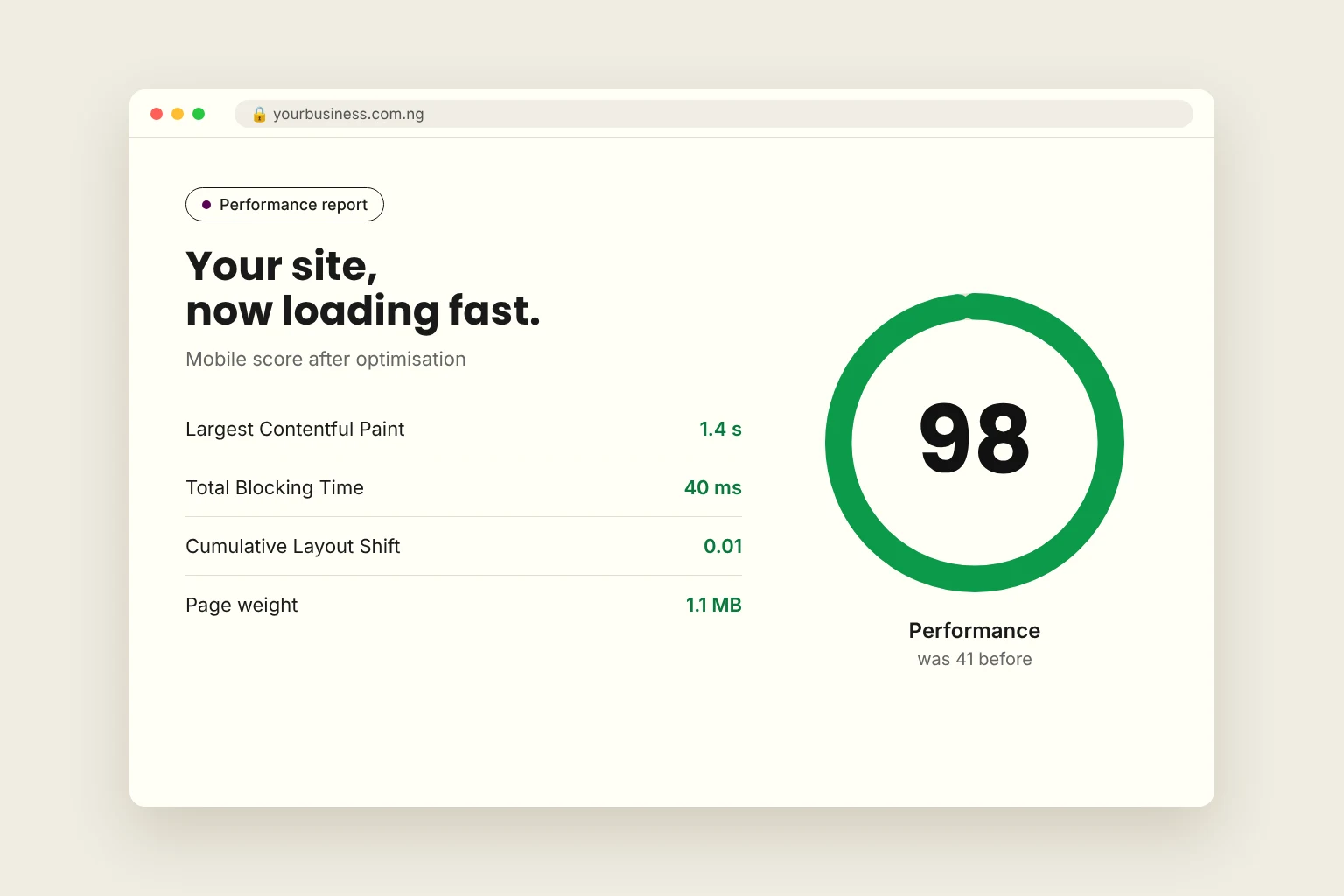

You have probably left a website because it took too long to load. Most people have. Your customers do exactly the same thing to your website, and most of them never tell you.
Website speed is not a technical detail for developers to worry about. It directly affects how many people see your offer, how many contact you and how Google ranks you.
Your customers are on their phones
Most web visits in Nigeria now come from mobile phones, according to StatCounter. Many of those visitors are on mobile data, sometimes on a weak signal, and often paying for every megabyte.
A page that loads instantly on office Wi-Fi can crawl on a phone in traffic. If your site is heavy, those visitors see a blank screen and leave before your page appears.
A beautiful website that takes eight seconds to load is an expensive billboard nobody sees.
Speed affects your search rankings
Google measures how real visitors experience your pages through a set of metrics called Core Web Vitals. They look at how quickly the main content appears, how fast the page responds when someone taps, and whether things jump around while loading.
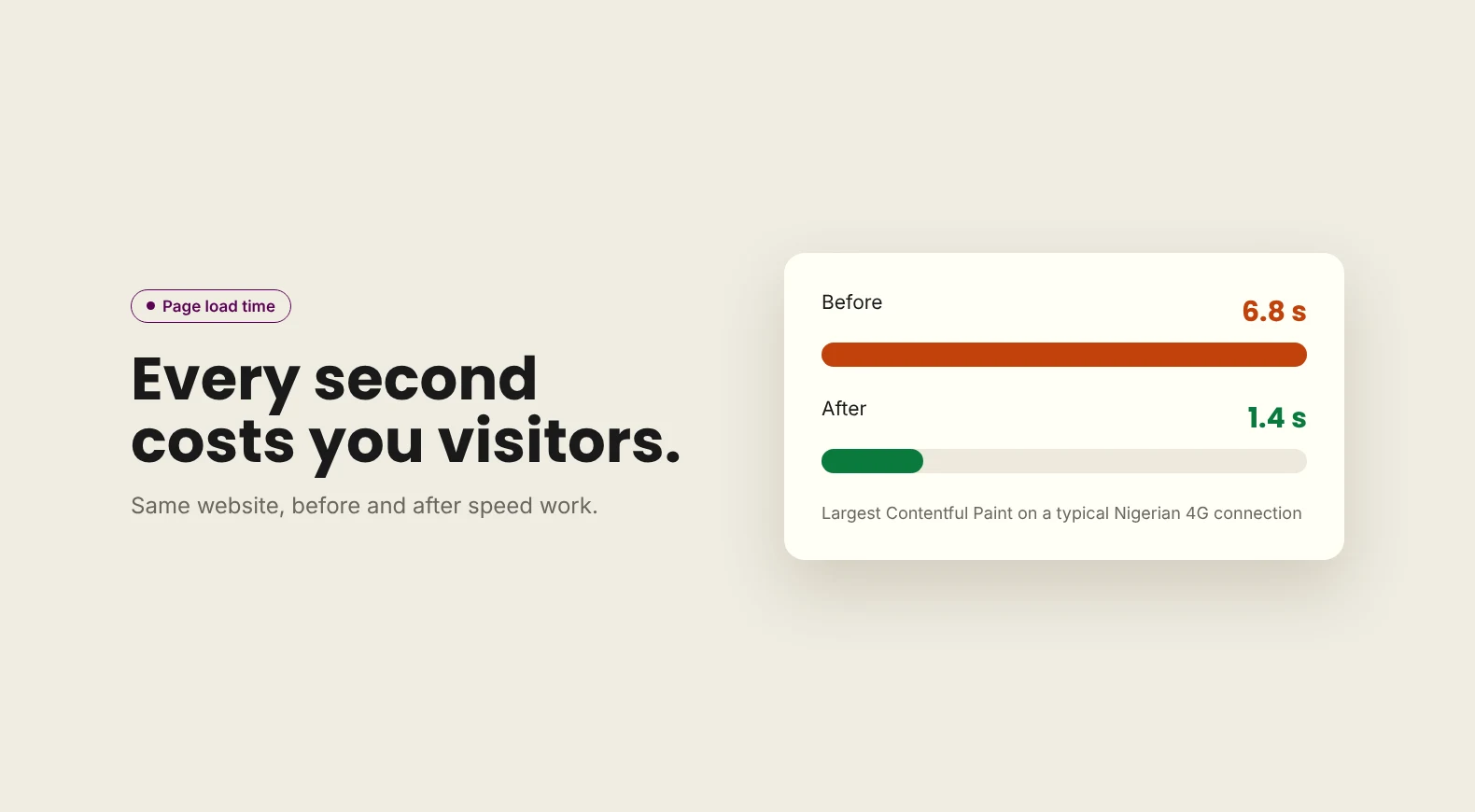
Speed is not the only ranking factor, but when two pages are similarly useful, the faster one has an advantage. A slow site makes it harder to win the searches that bring you customers.
What usually makes a website slow
In our experience, slow business websites share the same few problems:
- Oversized images. Photos uploaded straight from a camera or phone, often several megabytes each.
- Too many plugins. Each one adds code, and some add a lot.
- Heavy themes. Multipurpose themes that load features you never use.
- Cheap or overloaded hosting. Shared servers with too many sites and no caching.
- No caching. The server rebuilds every page from scratch for every visitor.
How to make your website faster
The fixes are usually practical rather than dramatic:
- Compress and resize images. Use modern formats like WebP and size images for the screen they appear on.
- Remove what you do not need. Delete unused plugins and features.
- Use caching. Serve ready-made pages instead of rebuilding them every time.
- Choose suitable hosting. A server matched to your traffic, ideally with good performance in your region.
- Load less up front. Delay non-essential scripts, such as chat widgets, until after the main content appears.
Measure before and after
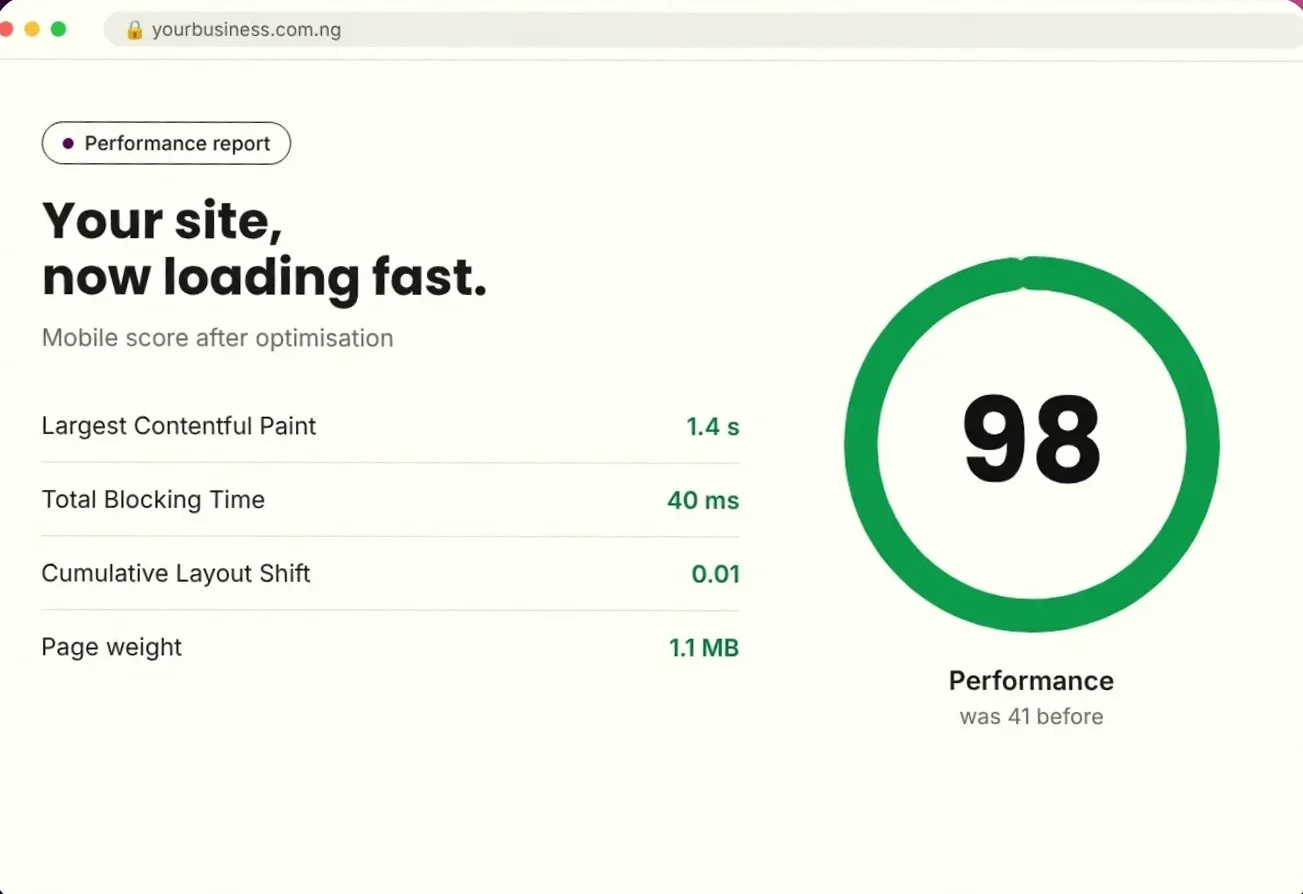
You cannot improve what you do not measure. Free tools like Google PageSpeed Insights show how your pages perform on mobile and desktop, and what is slowing them down.
Test your home page and your busiest service page. Write down the scores, make your changes, then test again. Always check mobile first, because that is where most of your visitors are.
Speed is not a one-off job
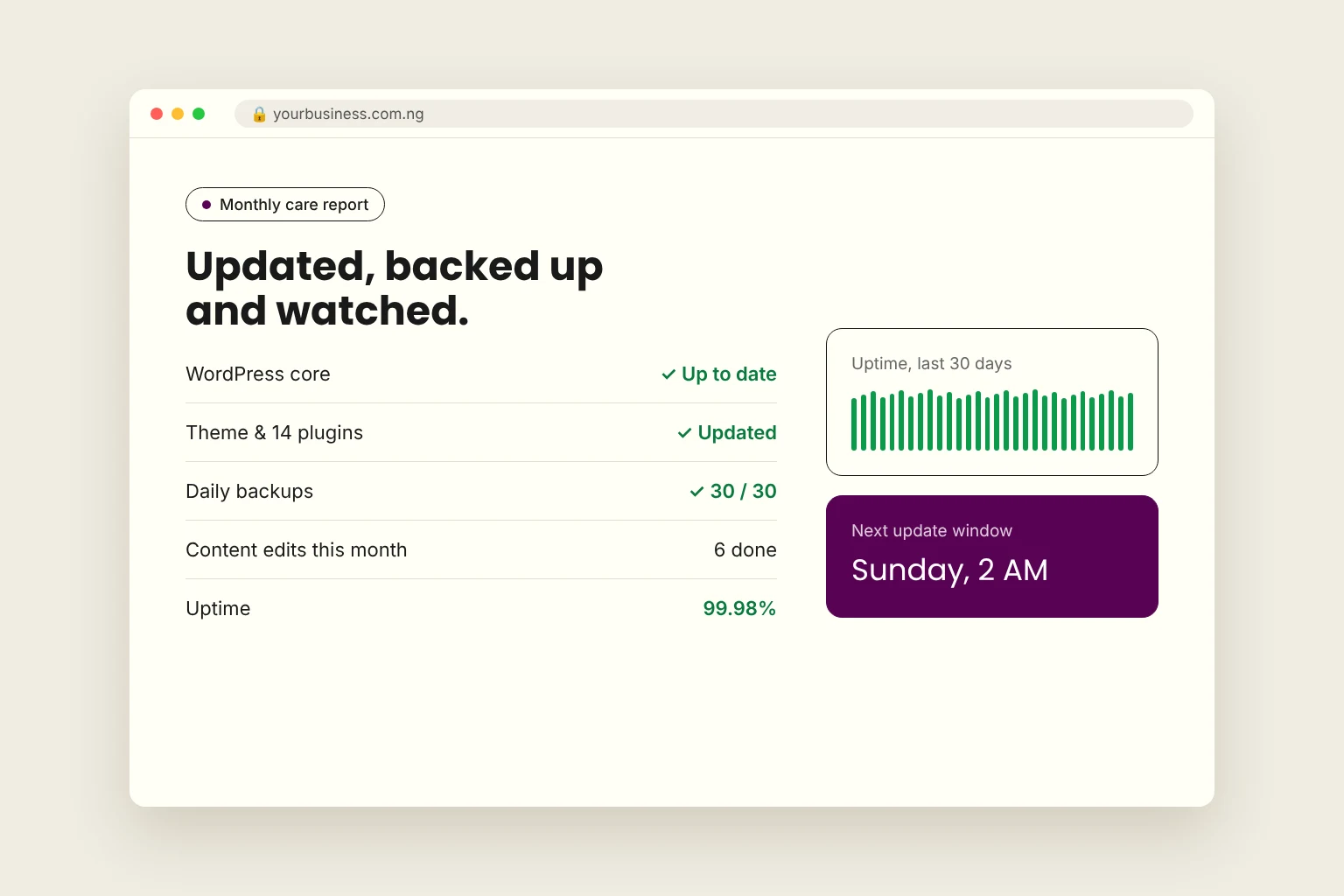
Websites slow down over time. New images get uploaded without compression, plugins pile up and content grows. A quick speed check as part of monthly maintenance keeps your site fast long after launch.
- Most of your visitors are on phones, often on mobile data.
- Speed affects both visitor behaviour and Google rankings.
- Images, plugins, themes and hosting are the usual culprits.
- Measure on mobile, fix the basics and check again every month.
The bottom line
Speed is one of the cheapest improvements you can make to a website, and one of the most valuable. Every second you save keeps more visitors on your page and gives your business a fairer chance to win them over.
Tell us about your business and we will recommend the right next step. The first consultation is free.